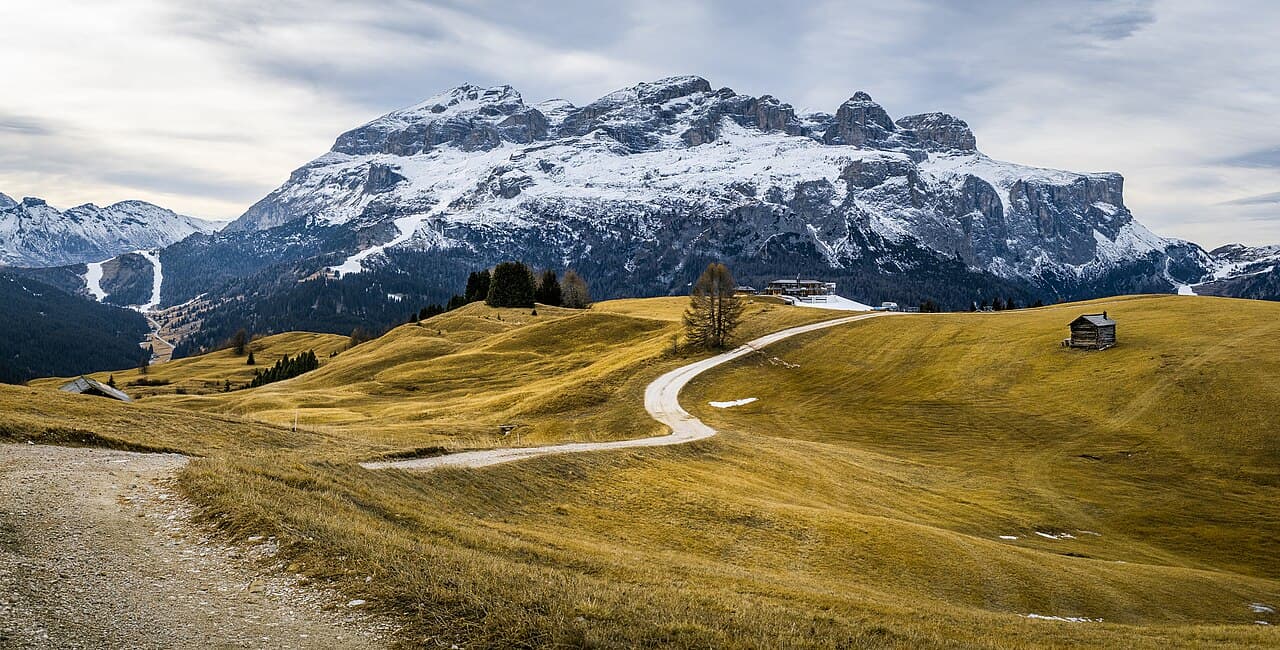
Alta Badia
Five Ladin villages under the Sella in South Tyrol, on one ski area of mostly blue and red runs, with the Sellaronda passing through Corvara and Colfosco.
Photo: Giuseppe Milo, CC BY 3.0, via Wikimedia Commons
- Villages
- 5
- Pistes
- 130 km
- Lifts
- 54
- Altitude
- 1,300–2,800 m
- Sellaronda
- About 40 km
- Nearest airport
- Bolzano
What is Alta Badia like?
Alta Badia is the upper end of the Val Badia, a Ladin-speaking valley in the Dolomites of South Tyrol, below the Sella massif. Five villages share its ski area: Corvara at 1,568 m, Colfosco at 1,645 m, San Cassiano at 1,537 m, and La Villa and Badia, which we have not yet covered on their own pages.
The tourist office counts 130 km of pistes between 1,300 m and 2,800 m, served by 54 lifts. Of those, 74 km are blue, 47 km red and 9 km black, so this is intermediate country. Alta Badia is also part of Dolomiti Superski, and the Sellaronda, the ski circuit round the Sella group, runs through two of its villages.
Where should you stay?
All five villages are on the same lifts and the same pass, so the choice is about where you start each day.
Corvara is the main village, with the Boè and Col Alto gondolas and the Sellaronda from the door. Colfosco is smaller and higher, on the road to the Passo Gardena, with its own lifts to the pass and to Col Pradat. San Cassiano is smaller, with the Piz Sorega gondola into the ski area and the Lagazuoi run coming back to the lifts nearby. La Villa sits at the foot of the Gran Risa, the World Cup slope.
Corvara
The Boè gondola to the Sella side and the Col Alto gondola to Pralongià leave the village, so the Sellaronda and the rest of Alta Badia start at the door.
San Cassiano
The Piz Sorega gondola reaches the plateau linking Corvara and La Villa, and the Lagazuoi run comes back to the lifts at Armentarola, below the Conturines.
Colfosco
Higher than Corvara, with its own lifts to the Passo Gardena and Col Pradat, and the Borest lift down to Corvara.
How the villages link
Four of the villages are lift-linked both ways; Badia's own lifts join La Villa by ski bus. Colfosco and Corvara are joined by the Borest lift. From Corvara the Col Alto gondola leads to the Pralongià plateau, and the same plateau is reached from La Villa and from San Cassiano by the Piz Sorega gondola; a red and a blue run come back down to San Cassiano.
The Sellaronda passes through Corvara and Colfosco only. San Cassiano and La Villa are not on the circuit: from either, you cross the plateau to Corvara first.
Over the Passo Gardena, Colfosco's lifts meet those from Selva, so Val Gardena is a ski away on the Dolomiti Superski pass.
Skiing Alta Badia
The tourist office names three signature descents: the Gran Risa World Cup slope at La Villa, the black Vallon–Boè in Corvara, and the Lagazuoi descent, which comes down from the Passo Falzarego to Armentarola near San Cassiano. More than 90 snowcats groom the slopes each night, according to the tourist office.

Sella Ronda
The Sellaronda is a circuit of lifts and runs round the Sella massif. It crosses four passes, the Campolongo, Pordoi, Sella and Gardena, and five resorts: Corvara and Colfosco in Alta Badia, Arabba, Canazei and Selva di Val Gardena. Alta Badia's tourist office gives it as about 40 km, 26 km of it on pistes, with about two hours on lifts and an hour and a half of skiing: allow around six hours. Orange signs mark the clockwise route, green the anticlockwise.
Val Gardena's tourist office measures it at 44 km, by a different route. The Val Gardena guide covers that side, including Ortisei, which is not on the circuit.
Lift passes
The Alta Badia pass covers the 130 km of pistes and 54 lifts across all five villages. The Dolomiti Superski pass covers, by Val Gardena's tourist office's count, 12 areas with 1,200 km of pistes and 450 lifts, and you need it for the Sellaronda and for skiing into Val Gardena or Arabba. The Ikon Pass also gives access to Dolomiti Superski.
At the time of writing, passes bought online at least two days ahead were 5% cheaper. Prices change with dates and length of stay, so we do not quote them: see the tourist office's ski pass page.
From 2026/27 the tourist office says a helmet is compulsory on all slopes, whatever your age.
Getting there
By road, the tourist office lists four ways in: from the Brenner in South Tyrol, from Lienz in Austria, and from Cortina d'Ampezzo or Agordo to the south.
The nearest railway station is Brunico, just over 30 km away, with buses into the valley; Bressanone and Bolzano are about 65 km away. Bolzano is the nearest airport. Venice, Treviso, Verona, Milan, Bergamo, Innsbruck and Munich are the alternatives, with shuttles and taxis to the valley. The South Tyrol Guest Pass covers regional public transport.
When to go
For 2026/27 the Alta Badia lifts are due to run from 4 December 2026 to 4 April 2027. Check the lifts, slopes and snow page for what is open on the day, and the tourist office's webcams and weather before you set off. In summer the lifts carry walkers.
Last checked: October 2026
Sources (16)
- Alta Badia: ski area (checked 3 October 2026)
- Alta Badia: skiing in Alta Badia (checked 3 October 2026)
- Alta Badia: Sellaronda ski tour (checked 3 October 2026)
- Alta Badia: ski pass prices and passes (checked 3 October 2026)
- Dolomites Val Gardena: Dolomiti Superski (checked 3 October 2026)
- Alta Badia: getting there and mobility (checked 3 October 2026)
- Alta Badia: Corvara (checked 3 October 2026)
- Alta Badia: San Cassiano (checked 3 October 2026)
- Alta Badia: Colfosco (checked 3 October 2026)
- Movimënt: Piz Sorega lift, San Cassiano (checked 3 October 2026)
- IDM Südtirol: Piz Sorega, San Cassiano (checked 3 October 2026)
- IDM Südtirol: Borest lift (checked 3 October 2026)
- Alta Badia: ski map 2025/26 (PDF) (checked 3 October 2026)
- Alta Badia: lifts, slopes and snow (checked 3 October 2026)
- Alta Badia: webcams (checked 3 October 2026)
- Alta Badia: weather (checked 3 October 2026)